www.conceptualizer.org

THE INDUSTRY FOUR
IMPACT
The Industry Four is a catalyst for transformative impact on Industry and Society. The Industry Four shapes the future with transformative impact. The Industry Four empowers with impactful innovation. We empower organizations to embrace change and drive innovation for a sustainable and all-inclusive future.
ti4 IMPACT

IMPACT: Inclusive Movement and Progressive Aspiration for Capability Transformation
The Industry Four IMPACT embodies the principles of Inclusive Movement and Progressive Aspiration for Capability Transformation, guiding organizations towards sustainable innovation and excellence in the Fourth Industrial Revolution. The IMPACT concept integrates Inclusive Movement, Progressive Aspiration, Capability, and Transformation to help organizations navigate the complexities of the Fourth Industrial Revolution. By embodying these principles, The Industry Four drives sustainable innovation and excellence, ensuring that every step is aligned with our inclusive perspectives focused on both industry and societal advancement.
- Inclusive: At The Industry Four, we prioritize inclusivity by integrating diverse industry and societal perspectives. Our approach ensures that technological and industrial advancements benefit all stakeholders, bridging the gap between industrial progress and societal well-being. By fostering inclusivity, we aim to create a more equitable and comprehensive future.
- Movement: Our focus on Movement involves strategically managing and advancing through the current phase of the Fourth Industrial Revolution towards the future momentum of the upcoming industrial era. This dynamic and collective effort is geared towards achieving shared goals, with each step meticulously aligned with our inclusive perspectives, which encompass both industry and societal needs.
- Progressive: We emphasize a progressive approach centered on continuous improvement and forward-thinking. Organizations are encouraged to set ambitious goals and pursue them with determination, ensuring they remain at the forefront of industry advancements and are well-prepared for future challenges. This progressive mindset drives ongoing evolution and innovation.
- Aspiration: Aspiration represents our commitment to excellence and high standards. The Industry Four motivates organizations to reach new heights by envisioning and striving towards a future where they lead in their respective fields. This aspiration provides the necessary drive and direction for sustained growth and success.
- Capability: We focus on enhancing organizational capabilities by equipping them with essential skills, knowledge, and tools. Through comprehensive training programs, assessments, and advisory services, The Industry Four prepares organizations to meet the demands of the Fourth Industrial Revolution, empowering them to implement advanced solutions and improve efficiency.
- Transformation: Transformation is central to our mission. We guide organizations through fundamental changes in capabilities, operations, and strategies. This transformative process is designed to foster sustainable growth and enable organizations to thrive amidst the evolving landscape of the Fourth Industrial Revolution.
▇ ▇ ▇ ▇
Viewing industrial revolutions through the lens of their impact on industry and society provides a meaningful perspective on how each phase of technological advancement has shaped the world. By examining industrial revolutions through their impact on industry and society, we can better understand the profound changes each revolution has brought about, not just in terms of technological advancements, but also in how these advancements have reshaped the way we live and work.
Let's move forward by viewing the industrial revolutions in terms of their impact.

IMPACT 1.0: The First Industrial Revolution
IMPACT 1.0 marks the beginning of the industrial era, characterized by the mechanization of production through groundbreaking innovations like the steam engine and textile machinery in the late 18th and early 19th centuries. This revolution fundamentally transformed economies, shifting them from agrarian-based systems to industrial manufacturing hubs, and led to the creation of factories that dramatically reduced reliance on manual labor. The social fabric of society also underwent significant change, with a mass migration of workers from rural areas to burgeoning cities, resulting in rapid urbanization and the emergence of a new working class. This period not only laid the groundwork for modern manufacturing but also profoundly altered societal norms and economic structures, marking a pivotal shift from agrarian to industrial economies and setting the stage for future technological advancements.
IMPACT 2.0: The Second Industrial Revolution
IMPACT 2.0 represents a period of rapid industrial expansion in the late 19th and early 20th centuries, driven by advancements in mass production, assembly lines, and electrification. This era saw significant economic growth as production efficiency soared, enabling the widespread availability of consumer goods and the expansion of global trade. Socially, living standards improved, and labor dynamics shifted with the introduction of standardized work processes. Industry was profoundly reshaped by these technological advancements, leading to the rise of large corporations and the standardization of products and processes on a global scale. The period also marked the rise of a more interconnected global economy, with industries expanding their reach and influence, further transforming the economic and social landscape and setting the stage for future innovations.
IMPACT 3.0: The Third Industrial Revolution
IMPACT 3.0 captures the transformative changes of the late 20th century, often referred to as the Digital Revolution, where the advent of computers, automation, and IT revolutionized industries by digitizing production processes and introducing new business models. This era marked the transition to knowledge-based economies, where information became a key asset, driving productivity and innovation. Socially, the revolution brought about greater connectivity and communication, though it also highlighted challenges such as the digital divide. The impact on industries was significant, with increased automation and efficiency fundamentally altering the way goods were produced and services were delivered, leading to rapid innovation and the reshaping of traditional business models. This period also laid the groundwork for the subsequent advancements in technology and business practices that continue to influence the modern digital landscape.
IMPACT 4.0: The Fourth Industrial Revolution
IMPACT 4.0, the current phase, is marked by the ongoing fusion of digital, physical, and biological systems through technologies like the Internet of Things (IoT), artificial intelligence (AI), big data, and advanced robotics. This revolution is creating smart factories where interconnected systems and real-time data analytics enable highly responsive and efficient production environments. Economically, IMPACT 4.0 is blurring the lines between industries, introducing new models centered on personalization and platform economies. Socially, it is reshaping work and lifestyles, raising ethical concerns around AI and automation, and emphasizing the need for sustainability. This era represents a profound shift toward adaptive manufacturing processes and continuous innovation, with industries now operating in a more interconnected and intelligent manner, driving them toward a future (Forthcoming Industrial Revoluion) where flexibility and intelligence are paramount.
ti4 IMPACT - TREE

THE INDUSTRY FOUR - As an Impact Platform.
THE INDUSTRY FOUR is an initiative to serve the industry & society. We serve the industry & society in the field of industry 4.0 digital transformation ecosystem. We serve the industry & society by our novel initiatives, standardization framework, industry ecosystem, and by our Learning & Consulting services.
The Fourth Industrial Revolution (or Industry 4.0) is the ongoing automation of traditional manufacturing and industrial practices, using emerging technology innovations. Industry 4.0 is simply the empowerment of Industry 3.0 with Digital Transformation. In this sense, it does not remain limited to just a technology evolution. It covers all the aspects of an enterprise including both business and technology.
Industry 4.0 is happening now. However, the vision and mission of “The Industry Four” are not limited to the current state of industry 4.0. For us Industry 4.0 is the starting point of our journey, leading towards the factory of the future or the forthcoming industrial revolution.
Aligned with our vision, "The Industry Four" is a blueprint of "fourth to forthcoming" industrial revolution. "The Industry Four" is about transition from Industry now to Industry next. It is an evolution of enterprise model. The Industry Four is about the evolution of Enterprise Model of Today to Enterprise Model of Tomorrow. The forthcoming revolution is about the inclusive growth of industry & society. This inclusiveness covers the dimensions of People, Planet, and Profit. Whereas, the fourth revolution is about Profit & Growth. However, the forthcoming revolution is about Sustainability & Support. It is about Supporting the Sustainability of our Planet, People, and Green Environment. Our initiatives are also aligned with this inclusiveness. "The Industry Four" is a transformation of traditional Industry to an all-inclusive IndusTREE.
Transformative IMPACT
The Industry Four is a catalyst for transformative impact. We empower organizations to embrace change and drive innovation for a sustainable and all-inclusive future for Industry & Society. The Industry Four is committed to creating meaningful impact. We partner with leaders to implement strategies that not only meet today's needs but also prepare for tomorrow's challenges. The Industry Four empowers with impactful innovation. Through our tailored solutions, we help businesses navigate the complexities of Industry 4.0 and beyond.
ti4 - The Industry Four
“ti4” stands for “The Industry Four” is the abbreviation derived from our company name “The Industry Four”. "The Industry Four" is the identity and epicenter of our portfolio of initiatives. "The Industry Four" is operating as the anchoring point of our existing initiatives and as well as for any upcoming initiatives. "The Industry Four" is an agile initiative that is continuously evolving along the pulse of progression. "The Industry Four" is an industry platform for the creation of thought leadership in the field of the industry 4.0 digital transformation.
The Industry Four TREE
The ti4 IMPACT framework, explained as The Industry Four TREE, provides a comprehensive approach to understanding the multifaceted effects of industrial revolutions. By analyzing technology, reforms, economy, and environment dimensions, we gain insights into how these revolutions drive progress while addressing their complex implications for society and industry. This holistic perspective is essential for navigating the evolving landscape shaped by Industry 4.0 and ensuring sustainable and equitable growth. The ti4 IMPACT concept offers a comprehensive framework for understanding the profound effects of industrial revolutions, particularly the Fourth Industrial Revolution (Industry 4.0). By focusing on four key dimensions—Technology, Reforms, Economy, and Environment—this model provides a multidimensional perspective on how revolutions shape industry and society.
ti4 IMPACT Overview
The ti4 IMPACT concept highlights how industrial revolutions bring about significant and multifaceted changes, not just in one direction but across multiple dimensions. The core idea is that revolutions encompass various evolutions happening simultaneously across different areas. This approach contrasts with the more linear and unidirectional nature of individual evolutions. The Fourth Industrial Revolution, driven by digital transformation and emerging technologies, illustrates how these multidimensional impacts manifest. The ti4 - The Industry Four TREE encapsulates the four dimensions of IMPACT: Technology, Reforms, Economy, and Environment.
A TREE-Based Core
- Technology (T) – Focuses on the evolution, integration, and disruption through technological advancement.
- Reforms (R) – Includes legal, governance, societal, and policy reforms necessary to adapt to industrial and technological changes.
- Economy (E) – Looks at the structure of production, consumption, business models, labor shifts, and economic policies.
- Environment (E) – Assesses both environmental consequences and eco-innovation brought by industrial revolutions.
This TREE foundation ensures a balanced view covering digital, developmental, economic, and ecological dimensions—often missing in traditional frameworks that focus mostly on tech and economy.
Each dimension represents a crucial aspect of how industrial revolutions influence and reshape industry and society, offering a holistic view of their multifaceted impacts. By integrating these dimensions, the ti4 IMPACT framework provides a structured approach to understanding and navigating the complexities of industrial revolutions, ensuring that technological advancements contribute positively across all areas of human activity.
Why TREE?
The TREE metaphor symbolizes growth, stability, and interconnectedness:
- Roots: Deep historical foundations of previous industrial revolutions (IMPACT 1.0 to 3.0).
- Trunk: The strong and transformative core of Industry 4.0.
- Branches: The four dimensions (Technology, Reforms, Economy, Environment) that extend and evolve.
- Leaves: The visible, societal and industrial impacts.
- Fruit: Sustainable, inclusive, and progressive development.
The Holistic Purpose
The ti4 IMPACT Framework encourages decision-makers, institutions, and learners to move beyond siloed technological perspectives. Instead, it fosters a systems-thinking mindset—integrating societal reforms, economic transformation, and environmental responsibility into every technological leap.
This approach is critical for:
- Strategic foresight and future readiness
- Building inclusive and human-centric innovation
- Driving sustainability and equitable growth in the 4IR era
IMPACT | Technology Dimension
IMPACT on Technology Dimension emphasizes the transformative effects of emerging technologies on industry & society. This includes:
- Accelerated Human Productivity: Technologies such as Cloud Computing, Big Data Analytics, IoT, AI, and automation enhance human capabilities, enabling smarter and faster decision-making.
- Rapid Technological Evolution: The pace of technological advancement accelerates change and progress, presenting both challenges and opportunities.
- Future Trends: Issues like climate change, new mobility solutions, and digitalization are both challenges and areas for growth. These technologies drive innovation and necessitate adaptation in various sectors to create a future roadmap from fourth to the forthcoming industrial revolution.
IMPACT | Reforms Dimension
IMPACT on Reforms Dimension focuses on the regulatory and policy changes required to adapt to the new industrial landscape. This includes:
- Public Policy and Governance: Effective policies are needed to harness the benefits of Fourth Industrial Revolution technologies while safeguarding societal interests.
- Regulatory Adaptations: Laws and governance models must evolve and adapt to address emerging ethical concerns, data privacy, security, and the responsible use of technology. These adaptations ensure that technological progress aligns with societal values and legal frameworks.
- Proactive Policymaking: Anticipating the impact of emerging technologies to create balanced frameworks that encourage innovation while safeguarding society.
IMPACT | Economy Dimension
IMPACT on Economy Dimension examines the economic transformations driven by industrial revolutions. Key aspects include:
- Economic Growth: Historical shifts from agrarian to manufacturing economies illustrate how revolutions accelerate economic growth and efficiency.
- Productivity and Competitiveness: Industry 4.0 technologies boost productivity, making companies more competitive and driving demand for higher-skilled labor.
- Economic Inequality: While technological advancements increase overall productivity, they also impact job structures, wages, and economic inequality.
IMPACT | Environment Dimension
IMPACT on Environment Dimension addresses the sustainability challenges posed by industrial advancements. This dimension highlights:
- Sustainability Concerns: Industrial growth has historically led to significant environmental impacts, including species extinction, deforestation, and climate change.
- Risk of Environmental Tipping Points: The accelerating pace of industrial activity risks crossing critical thresholds that could trigger severe environmental changes.
- Need for Sustainable Practices: Balancing industrial progress with environmental stewardship is crucial for sustainable development.
The IMPACT as a Concept

Why IMPACT Matters
The world is undergoing profound transformations driven by the Fourth Industrial Revolution. However, not all change is inherently positive—without direction, innovation can exacerbate inequality, disrupt livelihoods, and widen societal gaps. This is where IMPACT by THE INDUSTRY FOUR® becomes essential. It provides a purpose-driven framework that ensures technology and progress benefit both industry and society—not one at the expense of the other.
IMPACT stands for Inclusive Movement and Progressive Aspiration for Capability Transformation, acting as both a philosophy and an actionable model for organizations, institutions, and individuals. It connects technological innovation to human values, encourages equitable progress, and supports capability-building in an age of digital disruption. As industries evolve, the IMPACT framework ensures no one is left behind—bridging progress with purpose.
The Six Core Pillars of IMPACT
Each letter in IMPACT represents a fundamental principle that guides transformation:
- Inclusive
We believe innovation must serve all. IMPACT fosters cross-sector collaboration that bridges industrial growth with societal well-being, ensuring technological advancement benefits communities, businesses, and governments alike. - Movement
Progress is not static. We champion a dynamic, forward momentum, encouraging proactive adaptation to emerging industrial shifts. IMPACT views transformation as a movement—not just a moment—toward a shared and equitable future. - Progressive
At the heart of IMPACT is the belief in continuous improvement. We help organizations stay ahead by setting bold aspirations and nurturing a culture of relentless learning and evolution. - Aspiration
IMPACT fuels organizations to dream bigger and aim higher. We enable visionary leadership and transformative ambition, positioning stakeholders to not just survive disruption—but to lead through it. - Capability
Transformation needs preparation. We build capabilities through training, assessments, and advisory, ensuring organizations possess the right skills, knowledge, and systems to unlock the value of the Fourth Industrial Revolution. - Transformation
True transformation reshapes business models, mindsets, and missions. IMPACT guides stakeholders through deep, sustainable change that enhances resilience, drives innovation, and builds future-ready enterprises.
IMPACT Across the Industrial Revolutions
By framing industrial revolutions through the lens of their impact, THE INDUSTRY FOUR® repositions history as a tool for future strategy:
- IMPACT 1.0
Mechanization changed how societies worked. The steam engine ushered the industrial age, moving economies from rural to urban, manual to mechanical. - IMPACT 2.0
Electrification and mass production expanded global trade, consumer access, and industrial scalability. The world moved faster—and further—than ever before. - IMPACT 3.0
The Digital Revolution transformed industries with automation and information technology, pushing us into a knowledge economy and redefining productivity. - IMPACT 4.0
Today’s convergence of AI, IoT, robotics, and big data is creating smart, adaptive, and responsive systems. However, this also demands ethical, inclusive, and sustainable practices—which IMPACT is designed to guide.

IMPACT Across the Industrial Revolutions
By framing industrial revolutions through the lens of their impact, THE INDUSTRY FOUR® repositions history as a tool for future strategy:
- IMPACT 1.0
Mechanization changed how societies worked. The steam engine ushered the industrial age, moving economies from rural to urban, manual to mechanical. - IMPACT 2.0
Electrification and mass production expanded global trade, consumer access, and industrial scalability. The world moved faster—and further—than ever before. - IMPACT 3.0
The Digital Revolution transformed industries with automation and information technology, pushing us into a knowledge economy and redefining productivity. - IMPACT 4.0
Today’s convergence of AI, IoT, robotics, and big data is creating smart, adaptive, and responsive systems. However, this also demands ethical, inclusive, and sustainable practices—which IMPACT is designed to guide.
The Industry Four TREE: ti4 IMPACT Framework
The Industry Four TREE symbolizes a robust, multidimensional approach to understanding the deep and dynamic transformations brought by industrial revolutions, especially in the era of Industry 4.0. At its core is the ti4 IMPACT Framework, which defines four foundational dimensions:
- Technology
The evolving digital, physical, and biological technologies that redefine industry and reshape human lives. - Reforms
Regulatory shifts, governance adaptations, and public policy evolution that respond to and shape technological change. - Economy
Emerging business models, workforce dynamics, innovation ecosystems, and economic structures influenced by industrial revolutions. - Environment
The ecological consequences, sustainability imperatives, and climate-related transformations driven by industrial development and technological advancement.
The Four-Perspective Concept of the IMPACT Framework
The IMPACT Framework, through the lens of The Industry Four TREE (Technology, Reforms, Economy, Environment), introduces a 4-Perspective Analytical Model to systematically decode the evolution and transformation associated with each industrial revolution. These four perspectives help us understand the Why, How, What Went Right, and What Went Wrong, ultimately enabling a holistic view of industrial transformation. Here's how each perspective functions:
(The Foundational Logic of Evolution and Transformation)
The IMPACT framework interprets industrial revolutions not as isolated technological events, but as systemic responses to human aspirations, societal challenges, and ecosystemic imbalances. The 4-Perspective Concept provides a layered, iterative lens to understand WHY a transformation began, HOW it was enabled, WHAT it achieved, and WHERE it faltered. This analytical model brings together the philosophy of cause-effect relationships, strategic decision-making, and evolutionary intelligence, offering a robust foundation for both retrospective analysis and futuristic thinking.
Perspective 1: Needs, Wants, Challenges & Limitations (The WHY)
This perspective explores the foundational push behind the revolution. It identifies the driving motivations, pain points, and structural limitations that necessitated transformation in a particular dimension. It addresses the question:
“What problems were we trying to solve or overcome, and what needs or aspirations were we aiming to fulfill?”
It reflects the objective-setting stage, capturing the urgency and direction for change. These challenges and needs act as the catalysts or triggers for initiating transformation.
Perspective 2: Enablers, Drivers & Influencers (The HOW)
Once the why is clear, this perspective looks at what made the transformation possible. It highlights the tools, knowledge, policies, innovations, and influential forces that enabled the system to respond to its needs and challenges.
These factors function as means to an end, including both intentional solutions and unintentional breakthroughs that opened the path forward. This stage represents the input mechanism or the transformation engine.
Perspective 3: Good Impact / Positive Outcomes (The WHAT WENT RIGHT)
This perspective measures the success of the revolution in terms of positive changes and benefits across the respective dimension. It answers:
“What were the valuable outcomes that resulted from the changes? How did it improve industry, society, or the environment?”
These outcomes are the visible indicators of progress, showcasing the effectiveness of the solutions and how well the original problems were addressed.
Perspective 4: Bad Impact / Unintended Consequences (The WHAT WENT WRONG)
Every transformation also comes with costs, risks, and unintended consequences. This perspective critically analyzes the challenges, side effects, disruptions, and ethical dilemmas that emerged due to the same changes that brought progress.
It recognizes that:
“Every solution creates a new type of problem.”
This perspective acts as a reality check, often providing the starting point or motivation for the next wave of transformation, thus forming a continuous loop of industrial evolution.
Strategic Value of the 4-Perspective Approach
- Holistic Analysis: Provides a 360-degree understanding of each dimension’s transformation.
- Causal Clarity: Connects past problems to present solutions and their outcomes.
- Balance of Optimism and Realism: Acknowledges both achievements and failures.
- Evolutionary Insight: Identifies triggers for further evolution and next revolutions.
This model is not just a retrospective tool but a forward-thinking analytical strategy—a way to navigate future revolutions and transformations with wisdom, contextual understanding, and strategic foresight.

Why the IMPACT Framework is the FUTURE - READY Compass.
The IMPACT Framework is the Future-Ready Compass.
- Provides structured reflection for understanding past revolutions and planning future ones
- Helps in policy formulation, education, corporate transformation, and innovation road mapping.
- Enables ethical and sustainable innovation by learning from past consequences.
- Supports transdisciplinary learning and inclusive transformation by integrating technology, economy, society, and governance.
WHY IMPACT IS FUTURE - READY for any upcoming Industrial Revolution.
It’s multi-dimensional: integrates legal, social, ecological, and economic factors with tech.
It’s cyclical and evolutionary: understands that each revolution fixes problems of the last but creates new ones—thus calling for continuous transformation.
It’s philosophical and strategic: not just a model, but a thinking lens to view change—helpful for educators, policymakers, businesses, and learners.
It’s customizable and adaptive: can be applied in historical reviews (IMPACT 1.0 to 4.0) as well as foresight analysis for the Future.
How the IMPACT Framework is Unique
The IMPACT Framework developed by THE INDUSTRY FOUR® is a pioneering analytical and strategic tool that offers a multi-dimensional, layered, and evolutionary perspective on the industrial revolutions — not merely as technological transitions, but as transformations that deeply reshape industries, societies, and ecosystems. What makes IMPACT unique is its integrative and dynamic approach structured around four core dimensions – TREE: Technology, Reforms, Economy, and Environment — and four deep perspectives for each dimension — Needs & Challenges, Enablers & Influencers, Good Impact, and Bad Impact.
This positions IMPACT as a holistic transformation framework, rather than just an industrial or technological classification model. It goes beyond technological invention to examine why changes were needed, how they were implemented, what outcomes they created, and what new problems emerged as a result — a feedback-oriented structure rarely seen in classical frameworks.
The IMPACT Framework stands for Inclusive Movement and Progressive Aspiration for Capability Transformation. It reinterprets the narrative of the Industrial Revolutions (IMPACT 1.0 to IMPACT 4.0), not just as technological evolutions, but as socio-technical-economic transformations driven by diverse interplays of needs, enablers, and consequences. It does so by analyzing each industrial revolution through four core dimensions:
- Technology
- Reforms
- Economy
- Environment
…and four analytical perspectives within each dimension:
- Needs, Wants, Challenges & Limitations (The WHY)
- Enablers, Drivers & Influencers (The HOW)
- Good Impacts / Outcomes (The POSITIVE RESULT)
- Bad Impacts / Side Effects (The NEGATIVE RESULT)
This layered analysis creates a holistic 4×4 matrix per revolution, ensuring we not only celebrate progress but also learn from its adverse impacts and understand the deeper driving forces behind transformation. IMPACT integrates multi-dimensional thinking, societal integration, and future foresight in a manner that bridges the "What", "Why", "How", and "So what" — giving it depth, structure, and transformative potential.
Strategic Value of the IMPACT Framework
- Acts as a diagnostic tool to understand where we are in the journey of industrial evolution.
- Provides policy-making clarity for governments and institutions.
- Enables business foresight by balancing opportunity and risk.
- Offers educational value for universities and learners to understand cross-disciplinary implications.
- Helps in developing resilient innovation strategies that are both sustainable and inclusive.

IMPACT 1.0 – 1st Industrial Revolution (~1760–1840)
- Technology: Breakthroughs like steam engines, spinning jenny, and mechanical looms initiated the mechanization of production.
- Reforms: Led to the early formation of labor laws, the concept of patents, and government interest in regulating industrialization.
- Economy: Shifted from agrarian to industrial economies; the birth of factory systems and mass production; urban migration.
- Environment: Start of fossil fuel dependency (coal); rising smoke pollution and early signs of ecological impact in industrial cities.
IMPACT 2.0 – 2nd Industrial Revolution (~1870–1914)
- Technology: Advancements in electricity, steel, assembly lines, and communication (telegraph, telephone) enabled mass production and connectivity.
- Reforms: Rise of labor unions, education system expansion, and antitrust regulations to manage industrial monopolies.
- Economy: Rapid industrial growth, formation of global markets, rise of consumer goods industries, and urbanization scale-up.
- Environment: Massive use of natural resources, deforestation, water and air pollution increased significantly, laying groundwork for future ecological concerns.
IMPACT 3.0 – 3rd Industrial Revolution (~1970–2000)
- Technology: Introduction of computers, electronics, digital technology, and the internet transformed how work and communication occurred.
- Reforms: Emergence of cyber laws, data protection acts, deregulation policies in telecom and finance, and formation of global environmental pacts.
- Economy: Birth of the knowledge economy, expansion of services sector, and globalization through IT and communication networks.
- Environment: Emergence of e-waste, global warming concerns, yet also the beginning of clean energy dialogues and sustainability activism.
IMPACT 4.0 – 4th Industrial Revolution (2000–Present)
- Technology: Convergence of AI ML - Artificial Intelligence & Machine Learning, robotics, big data, IoT, blockchain, quantum tech, and 5G defines a cyber-physical revolution.
- Reforms: New policies for digital rights, ethical AI, ESG governance, Cyber Security, privacy laws (like GDPR), and startup regulation.
- Economy: Rise of the platform economy (Uber, Airbnb), gig work, digital entrepreneurship, decentralized finance, and automation-driven value chains.
- Environment: Strong push for sustainability through green tech, ESG standards, carbon neutrality goals, and climate-conscious innovation (e.g., climate AI, green hydrogen).
The 4 Perspective Analytical Model of the IMPACT Framework
The Four-Perspective Analytical Model of the IMPACT Framework
The IMPACT Framework is designed to analyze the evolution and impact of industrial revolutions across four critical dimensions—Technology, Reforms, Economy, and Environment (TREE). It does so through a Four-Perspective Model that allows us to deeply understand not only what changed, but why, how, and with what consequences. This approach uniquely positions IMPACT as a comprehensive, contextual, and future-facing analytical tool.
Uniqueness of the IMPACT Framework by THE INDUSTRY FOUR®
The IMPACT Framework (Inclusive Movement and Progressive Aspiration for Capability Transformation) stands apart as a holistic, multi-dimensional lens to understand and navigate industrial revolutions. Unlike traditional historical narratives or technology-centric models, this framework introduces a value-integrated, systems-level perspective that bridges industry, society, policy, and capability building across generations of transformation.
Here’s what makes it unique and powerful:
A. Perspective-Based Analysis of Industrial Revolutions
Rather than just stating “what happened” during industrial revolutions, IMPACT introduces a 4-dimensional view:
- Technology
- Society
- Economy
- Reforms (Policy & Governance)
Each of these is analyzed in two layers:
- Drivers (Enablers / Influencers) – What contributed to transformation
- Outcomes (Impacts) – What we gained or suffered from
This dual-layered, 4D analysis helps us understand the full cycle of change, rather than just its technological or economic features.
B. Positive-Negative Dual Lens
Most existing narratives on industrial revolutions are linear and glorify the “progress.” But the IMPACT framework critically evaluates both gains and challenges:
- For each dimension, we look at 4 positive outcomes (benefits) and 4 negative consequences (threats).
- This supports balanced decision-making, risk awareness, and ethical strategy design.
It also reveals hidden costs—such as environmental damage, labor exploitation, policy lag, or income disparity—that are often ignored.
C. Integration of Policy, Governance & Reforms
The “Reforms” dimension is a rarely discussed lens in traditional frameworks. The IMPACT Framework positions public policy, governance, legal systems, and institutional reforms as core enablers and outcomes of each industrial revolution.
This allows:
- A deeper understanding of regulatory evolution
- Better insights for future governance transformation
- A bridge between technical revolutions and public value systems
D. Structured, Scalable & Modular Design
IMPACT is built with symmetry and systematization:
- 4 Dimensions × 4 Drivers × 4 Positive Outcomes × 4 Negative Outcomes = A robust matrix of analysis
- This structure enables easy expansion across different generations (IMPACT 1.0 to 4.0) and even future revolutions (IMPACT 5.0 and beyond)
It is modular enough to apply across industries, countries, and educational levels, making it suitable for consulting, curriculum, research, or policy work.
E. Bridging Industry and Society
Most transformation models are either industry-specific (like digital maturity models) or policy-based (like government roadmaps). IMPACT merges these by:
- Considering societal implications such as labor shifts, cultural evolution, and inclusivity
- Relating business and industry growth to human development and collective well-bein
This makes it a truly inclusive transformation framework—one that doesn't just ask "how do we scale technology" but also "who benefits and who gets left behind?"
F. Aligned with Future-Ready Capability Development
IMPACT naturally aligns with lifelong learning, interdisciplinary skill-building, and transformation-led capability development, supporting:
- Reskilling and upskilling pathways
- Entrepreneurial and innovation mindsets
- Cross-functional knowledge for future careers
It ties directly to our other concepts and Frameworks. Together, these ecosystems form an interconnected thought leadership platform, with IMPACT as the historical and strategic foundation.
Perspective 1: Needs, Wants, Challenges & Limitations (The WHY Behind Change)
This first perspective uncovers the fundamental drivers of transformation. It addresses the "Why" — the internal and external pressures, constraints, and aspirations that create the need for progress. In the context of industrial revolutions, this may include:
- Technological Gaps: Lack of efficiency, high manual labor, limited output, or slow communication.
- Social or Legal Constraints: Inequities, outdated laws, or lack of governance mechanisms.
- Economic Needs: Rising demand, global competition, resource scarcity, or financial instability.
- Environmental Pressures: Pollution, resource overuse, or climate-related challenges.
This perspective provides context and purpose — the motivational forces that push societies and industries toward new paradigms.
Strategic Purpose: It helps identify root causes, setting the direction and objectives for transformation.
Perspective 2: Enablers, Drivers & Influencers (The HOW of Transformation)
This perspective focuses on "How" the transformation was achieved — what made the change possible. These are the catalysts and mechanisms that allowed societies to meet the needs and overcome the challenges from Perspective 1.
- Technological Enablers: Inventions, tools, digitization, connectivity.
- Reform Enablers: Policies, legal frameworks, social movements.
- Economic Influencers: Capital access, industrial investments, trade liberalization.
- Environmental Enablers: Renewable energy, sustainability awareness, regulatory frameworks.
This perspective provides insight into the pathways of execution, the infrastructure of change, and the players involved (governments, corporations, inventors, communities, etc.).
Strategic Purpose: Identifies levers and strategies that were most effective in enabling change.
Perspective 3: Good Impact / Positive Outcomes (Performance and Achievements)
This is the "What went right" perspective. It assesses positive results that emerged as a result of the changes driven by the first two perspectives. These impacts can include:
- Technological: Increased efficiency, innovation, reduced labor, improved communication.
- Reform-based: Enhanced rights, better governance, social equality, legal modernization.
- Economic: Growth in GDP, better employment, improved trade, entrepreneurship.
- Environmental: Cleaner processes, better waste management, sustainability policies.
This view highlights the benefits and success stories, helping to evaluate performance and justify transformation efforts.
Strategic Purpose: Helps validate the transformation journey and identify best practices for replication.
Perspective 4: Bad Impact / Limitations & New Challenges (Unintended Consequences)
Every solution also introduces new problems, and this perspective acknowledges that. It evaluates what didn’t work, or what new challenges emerged as side-effects of the adopted transformations.
- Technology: Job loss, digital divide, surveillance, over-dependence.
- Reforms: Bureaucracy, resistance to change, enforcement gaps, inequality in implementation.
- Economy: Wealth gap, market monopolies, boom-bust cycles, inflation.
- Environment: Pollution, deforestation, overproduction, industrial waste.
This is a forward-looking lens that allows us to learn from the limitations of the past and initiate the next cycle of innovation and correction. Strategic Purpose: Reveals the need for future improvements, driving the evolution toward the next phase of industrial transformation.

tiforum
Sustainable Pathway
tiforum Sustainable Pathways is our initiative to promote the goals of UNDP SDG and partner with industry & society to achieve these goals.
Sustainable Pathway

THE INDUSTRY FOUR - Sustainability with Growth
Sustainability is crucial in the age of THE INDUSTRY FOUR (fourth to forthcoming industrial revolution) because this era of technological advancement brings both opportunities and challenges to achieving sustainable development. Sustainability is critical in the age of THE INDUSTRY FOUR because it ensures that technological advancement is aligned with the principles of sustainable development, which include environmental protection, social inclusion, and economic growth. Without sustainability, the benefits of THE INDUSTRY FOUR may not be accessible to all and could exacerbate existing inequalities and environmental challenges.
The Industry Four is characterized by the integration of various technologies that can help reduce waste, increase resource efficiency, and promote renewable energy. However, these technologies must be implemented in a sustainable manner to avoid negative impacts on the environment and society. For example, the production of electronic devices such as smartphones and laptops requires the mining of minerals and rare earth metals, which can have significant environmental and social consequences if not managed sustainably.
Further,The Industry Four can contribute to sustainable development by enabling the transition to a circular economy, where products and materials are reused, repaired, or recycled. This can help reduce waste and promote resource efficiency. However, the implementation of a circular economy requires systemic changes in the way goods are produced and consumed, which requires a coordinated effort from government, business, and civil society.
Moreover, The Industry Four can promote sustainable agriculture by providing farmers with data and insights on soil health, weather patterns, and crop yields. This can help reduce the use of pesticides and fertilizers, and improve the efficiency of resource use. However, the adoption of these technologies must be accompanied by sustainable farming practices that protect soil health, biodiversity, and water resources.
Turn sustainability into a new source of value.
■ ■ ■ ■
"Turn sustainability into a new source of value" signifies a transformative shift in our approach to business and the world around us. By integrating sustainable practices into our operations, we not only contribute to a healthier planet but also unlock untapped opportunities for growth and innovation. Sustainability becomes more than a responsibility – it becomes a strategic advantage, attracting conscious consumers, fostering loyalty, and driving long-term profitability. Embracing sustainability isn't just a choice; it's a chance to shape a brighter future while reaping the rewards of a more resilient and purpose-driven business model and operating model.
The future of industry growth is GREEN.
■ ■ ■ ■
"The future of industry growth is GREEN" heralds a profound evolution in how we envision progress. As industries worldwide pivot towards sustainable practices, the emphasis on environmental consciousness becomes the cornerstone of growth. By integrating green technologies, reducing carbon footprints, and embracing eco-friendly processes, we don't just ensure a healthier planet but also pave the way for economic prosperity. This shift isn't a constraint; it's an opportunity to innovate, create jobs, and lead the charge towards a more sustainable and equitable future. By aligning growth with environmental stewardship, we set the stage for a thriving, resilient, and truly green tomorrow.
Empowering Sustainable Transformation
■ ■ ■ ■
Partnering with Industry and Society to Deliver the UNDP Sustainable Development Goals.
tiforum Sustainable Pathways is our dedicated initiative under tiforum | Forum for THE INDUSTRY FOUR, aimed at advancing the United Nations Sustainable Development Goals (UNDP SDGs) through collaborative, inclusive, and impactful engagement with both industry and society. This initiative is built on our belief that sustainable development is not just a responsibility but a strategic imperative for long-term industrial and societal progress. Through tiforum Sustainable Pathways, we strive to align industrial growth with environmental stewardship, social equity, and economic resilience. We engage with organizations, institutions, and community stakeholders to co-create action-oriented strategies that integrate sustainability into core business and operational practices. Our focus areas include climate action, quality education, decent work, responsible consumption, industry innovation, and reduced inequalities—each supported by thought leadership, training, dialogue forums, and collaborative projects. By fostering cross-sectoral partnerships, encouraging systems thinking, and promoting innovation with purpose, tiforum Sustainable Pathways empowers stakeholders to become active contributors to the global sustainability agenda. This initiative not only drives awareness and accountability but also transforms intent into action—creating measurable outcomes that resonate with the values of Industry 5.0 and the broader mission of building a more sustainable, inclusive, and future-ready world.
Building a Sustainable Future
■ ■ ■ ■
Building a Sustainable Future - For a Responsible Tomorrow.
tiforum Sustainable Pathways is a strategic initiative by tiforum | Forum for THE INDUSTRY FOUR that reinforces our commitment to supporting the United Nations Sustainable Development Goals (UNDP SDGs). This initiative is designed to create meaningful bridges between industry and society, fostering collaboration that drives sustainable and inclusive progress. We work with enterprises, institutions, and communities to embed sustainability into the fabric of industrial practices—ensuring growth is aligned with environmental responsibility, social inclusion, and long-term resilience.
tiforum’s Commitment
■ ■ ■ ■
tiforum’s Commitment to Purpose-Driven Growth and Social Impact.
Through knowledge sharing, partnerships, training programs, and collaborative platforms, tiforum Sustainable Pathways empowers stakeholders to take tangible steps toward goals such as climate action, sustainable industry, equitable education, decent work, and innovation-driven development. Our mission is to transform sustainability from a peripheral concern into a central pillar of industrial transformation. By aligning with the principles of Industry 5.0 and global sustainability standards, we aim to shape an ecosystem where progress benefits people, planet, and prosperity in equal measure.
tiforum Sustainable Pathway 4 Steps Framework
■ ■ ■ ■
A Pathway towards Net Zero
In recent years, the issue of climate change has become a pressing concern for individuals, organizations, and governments worldwide. As the effects of global warming continue to intensify, there is a growing consensus that we must take immediate action to mitigate its impact. One such solution is the adoption of a sustainable pathway towards achieving a net-zero future. To align ourselves to the motive and purpose of UNDP SDG, we have specifically included it in our tiforum initiatives. As a part of tiforum orbits, we have named it tiforum Sustainable Pathway.
A sustainable pathway is an approach that emphasizes the integration of social, economic, and environmental concerns in decision-making processes. It is a holistic approach that considers the long-term impacts of our actions on the planet and future generations. The goal of a sustainable pathway is to create a world in which economic growth and environmental protection go hand in hand.
Achieving net-zero is a crucial aspect of a sustainable pathway. Net-zero means that the amount of greenhouse gas emissions we produce is equal to the amount of greenhouse gases we remove from the atmosphere. This is achieved through a combination of reducing emissions and implementing strategies that remove carbon dioxide from the atmosphere, such as afforestation and reforestation, carbon capture and storage, and the use of renewable energy sources.
Adopting a sustainable pathway towards net-zero is not only essential for mitigating the impact of climate change but also for creating a more prosperous and equitable world. By prioritizing the reduction of our carbon footprint, embracing circular economy principles, adopting sustainable land-use practices, prioritizing sustainable transportation solutions, and working towards a just transition, we can create a world that is more resilient, equitable, and sustainable for generations to come.
We must work towards achieving a just transition to a net-zero economy. This means ensuring that the benefits of a net-zero future are distributed fairly across society, including vulnerable and marginalized communities. It also means ensuring that workers in industries that are being phased out, such as fossil fuels, are supported through retraining and reskilling programs.
There are several steps that we can take to adopt a sustainable pathway towards net-zero.

Reducing Greenhouse Gas Emissions
■ ■ ■ ■
A sustainable pathway requires a significant reduction in greenhouse gas emissions across all sectors. The burning of fossil fuels for energy production, industrial processes, transportation, and agriculture contributes to a large portion of global emissions. Transitioning to renewable energy sources such as solar, wind, and hydropower, along with improving energy efficiency, is crucial for reducing carbon footprints. Additionally, sustainable transportation systems, including electric vehicles and improved public transit, can contribute to emission reductions.

Embracing Circular Economy
■ ■ ■ ■
The traditional linear economic model of "take-make-dispose" is unsustainable and depletes natural resources. Embracing a circular economy is a vital component of a sustainable pathway towards net zero. This approach aims to minimize waste, promote recycling and reuse, and design products with longevity in mind. By shifting towards a circular economy, we can reduce the extraction of raw materials, conserve energy, and minimize the environmental impact associated with production and consumption.
Promoting Sustainable Land Use
■ ■ ■ ■
Land use practices significantly impact the environment, biodiversity, and climate. Unsustainable agriculture, deforestation, and urban sprawl contribute to greenhouse gas emissions, soil degradation, and loss of wildlife habitats. Adopting sustainable land use practices, such as regenerative agriculture, reforestation, and land restoration, can help sequester carbon, preserve ecosystems, and enhance biodiversity. Furthermore, integrating sustainable urban planning that promotes compact cities, green spaces, and efficient infrastructure can contribute to mitigating climate change.

Investing in Green Technologies and Innovation
■ ■ ■ ■
Technological advancements play a pivotal role in the transition to a sustainable future. Investing in research and development of green technologies can accelerate the shift towards renewable energy, energy storage, and energy-efficient systems. Innovations in areas such as carbon capture and storage, sustainable materials, and smart grid systems can provide viable solutions for achieving net-zero emissions. Moreover, fostering collaboration between governments, businesses, and academia can facilitate the development and implementation of sustainable innovations.
Our initiative is aligned with global initiatives.

Sustainability can't be a standalone initiative. It requires a sustainable ecosystem.
As the world grapples with the challenges of climate change and environmental degradation, the need for sustainable solutions has become more urgent than ever. One of the key objectives in combating these issues is achieving net-zero emissions, which means balancing the amount of greenhouse gases emitted with the amount removed from the atmosphere. To reach this ambitious goal, society must embark on a sustainable pathway that prioritizes eco-friendly practices and embraces innovative solutions. In this article, we will explore the significance of a sustainable pathway in the journey towards a net-zero future.
THE INDUSTRY FOUR supports the SDG - Sustainable Development Goals of UNDP. To align ourselves with the motive and purpose of UNDP SDG, we have specifically included it in our tiforum initiative.
A sustainable pathway is the key to achieving net-zero emissions and mitigating the adverse effects of climate change. By prioritizing the reduction of greenhouse gas emissions, embracing a circular economy, promoting sustainable land use, investing in green technologies, and engaging communities, we can pave the way towards a more sustainable future. The journey towards net zero requires collaboration, innovation, and a collective commitment to creating a healthier planet for current and future generations. Together, we can forge a sustainable pathway that ensures a greener, cleaner, and more resilient world.
Building a sustainable future requires widespread awareness and active participation from individuals, communities, and organizations. Education and public engagement play a crucial role in driving behavioral changes and fostering sustainable practices. Promoting environmental literacy, providing resources for sustainable living, and encouraging responsible consumption can empower individuals to make informed choices that support the transition to a net-zero society.
As a part of tiforum orbits, we have named it tiforum Sustainable Pathway. tiforum Sustainable Pathway is focused on turning sustainability into a new source of value. Sustainable Development is the development that meets the needs of the present without compromising the ability of future generations to meet their own needs. Sustainability is central to our purpose. We are committed to creating positive impacts in society through our initiatives and our expertise.
Technology for life
Technology for life is about the sustainability of the environment & life on earth. In line with our definition of "THE INDUSTRY FOUR", we endorse the SDG - Sustainable Development Goals of UNDP.
UNDP SDG
UNDP SDG was adopted by all United Nations Member States in 2015 as a universal call to action to end poverty, protect the planet and ensure that all people enjoy peace and prosperity by 2030.
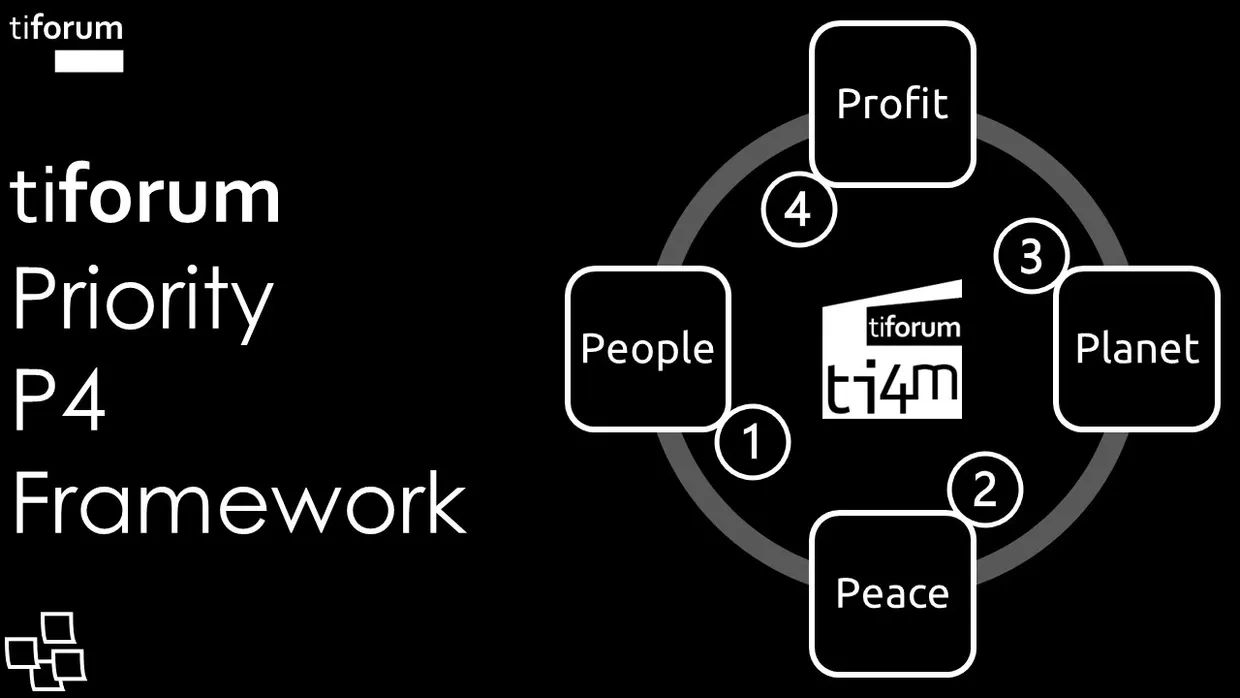
tiforum Priority P4 Framework
tiforum’s Commitment to Purpose-Driven Growth and Social Impact.
tiforum Sustainable Pathways is a strategic initiative by tiforum | Forum for THE INDUSTRY FOUR that reinforces our commitment to supporting the United Nations Sustainable Development Goals (UNDP SDGs). This initiative is designed to create meaningful bridges between industry and society, fostering collaboration that drives sustainable and inclusive progress. We work with enterprises, institutions, and communities to embed sustainability into the fabric of industrial practices—ensuring growth is aligned with environmental responsibility, social inclusion, and long-term resilience. Through knowledge sharing, partnerships, training programs, and collaborative platforms, tiforum Sustainable Pathways empowers stakeholders to take tangible steps toward goals such as climate action, sustainable industry, equitable education, decent work, and innovation-driven development. Our mission is to transform sustainability from a peripheral concern into a central pillar of industrial transformation. By aligning with the principles of Industry 5.0 and global sustainability standards, we aim to shape an ecosystem where progress benefits people, planet, and prosperity in equal measure.
Building a Sustainable Future - For a Responsible Tomorrow.
As an industry and society, we must work together to ensure a sustainable future because what we do today sets the foundation for what’s possible tomorrow. tiforum Priority P4 Framework defines the priorities of Industry for establishing a profitable business model, while also considering other important factors, which are People, Peace, Planet, and Profit.
.webp/:/rs=w:600,cg:true,m)
1. People -
People are the representation of society along with industrialization. The theme of the forthcoming industrial revolution is for the people and by the people. The ultimate goal of the forthcoming industrial revolution is to serve society in an all-inclusive way. Whereas the concept of Dark Factory represents the minimum involvement of humans on the shop floor. However, the forthcoming industrial revolution demands the working of humans along with robots. The human mind's creativity and intelligence cannot be replicated by the algorithms of AI - Artificial Intelligence.
.webp/:/rs=w:600,cg:true,m)
2. Peace -
Peace is the representation of global brotherhood. Peace is equally important to enjoy prosperity. We can only cultivate the true potential of an industrial revolution, by implementing global business models and establishing global supply chains. Peace is at the center of excellence to achieve this motive. Peace is required to build a synchronized harmonization among global societies. Peace is a crucial factor to cultivate the shared resources of nature in the most efficient way. For the sustainable future of Industry & Society, Peace is a mandatory factor.
.webp/:/rs=w:600,cg:true,m)
3. Planet -
The planet is the representation of the environmental ecosystem. Being social animals, we have a strong dependency on our environmental ecosystem. Exploiting the ingredients this ecosystem is becoming a high-severity risk for the existence and survival of human beings. We have to cultivate the resources of nature in an optimized way to save the future of Industry & Society. We have to preserve our Planet for our future.
.webp/:/rs=w:600,cg:true,m)
4. Profit -
Profit is the representation of profit with sustainability and growth. In the forthcoming industrial revolution, we should consider Profit in an inclusive way along with People, Peace, and Planet. A profit achieved by impacting any ingredient of the Priority P4 framework in a negative way should be considered a loss. To achieve sustainable growth, we have to consider sustainability as our profit center and include it in our corporate strategy.

THE INDUSTRY FOUR
Portfolio of Initiatives
We execute our Vision and Mission via our Initiatives. To serve the industry & society, we regularly take diversified initiatives.

tiforum
FORUM FOR THE INDUSTRY FOUR
We are keen to join hands with organizations where we can serve the Industry & Society, aligned with our vision and mission. We are executing our industry participation & partnership program via our initiative tiforum integrated ecosystem. To know more about tiforum, navigate & explore via below link.
tiforum Integrated Ecosystem

THE INDUSTRY FOUR®
Who We Are?
▇ ▇ ▇ ▇
THE INDUSTRY FOUR®
▇ ▇ ▇ ▇
We are a Research Initiative.
∎ We consistently perform extensive research to develop and design our management standardization frameworks.
We are a Training Academy.
∎ We deliver our educational services through our training products, guided by our standardization frameworks.
We are a Consulting Practice.
∎ We provide our consulting services aligned with our portfolio of products, and standardization frameworks.

THE INDUSTRY FOUR®
▇ ▇ ▇ ▇
THE INDUSTRY FOUR® is an initiative aimed at serving the industry & society within the context of the fourth to forthcoming industrial revolution and transformation ecosystem. We achieve this through our novel initiatives, standardization framework, industry ecosystem, and our learning and consulting services.
Fourth to Forthcoming ❯
▇ ▇ ▇ ▇
THE INDUSTRY FOUR® is a Blueprint of Fourth to Forthcoming Industrial Revolution. Whereas the fourth revolution is about Profit & Growth. However, the forthcoming revolution is about Sustainability & Support. It is about Supporting the Sustainability for our Planet, People, Peace, and Green Environment.
Industry 4.0 is the starting point of our journey.
▇ ▇ ▇ ▇
THE INDUSTRY FOUR®
Industry Now to Industry Next: Embracing the fourth to forthcoming industrial revolution.
THE INDUSTRY FOUR® is about Industry NOW to Industry NEXT.
The business landscape is constantly evolving, and it is crucial for organizations to adapt and embrace change to stay competitive. The world is witnessing an unprecedented pace of change, driven by groundbreaking technologies and innovative ideas. From the first industrial revolution that harnessed steam power, to the current era of digital disruption, industrial revolutions have shaped the course of history, propelling industries forward and revolutionizing the way we live and work.
In today's rapidly evolving world, the concept of industrial evolution and revolution plays a pivotal role in shaping the future of businesses. Industrial evolution refers to the gradual changes and advancements that occur within an industry over time. It involves the adoption of new technologies, processes, and business models to enhance productivity and efficiency. Embracing industrial evolution allows organizations to keep pace with market demands and take advantage of emerging opportunities. Whereas Industry 4.0 is happening now. However, the vision and mission of THE INDUSTRY FOUR® are not limited to the current state of industry 4.0. For us Industry 4.0 is the starting point of our journey, leading towards the factory of the future or the forthcoming industrial revolution. Aligned with our vision, THE INDUSTRY FOUR® is about fourth to forthcoming industrial revolution. THE INDUSTRY FOUR® is about Industry now to Industry next. THE INDUSTRY FOUR® is about mapping the method to manage and mature the moment of movements from the current moment of the fourth industrial revolution towards the future momentum of the forthcoming industrial revolution.
An industrial revolution represents a profound and rapid shift that completely transforms industries and societies. It is characterized by the introduction of revolutionary technologies, new manufacturing processes, and disruptive business models. Industrial revolutions disrupt traditional practices, open up new avenues for growth, and reshape entire industries. They empower organizations to reimagine possibilities, challenge the status quo, and embrace groundbreaking innovations that propel them from the industry now to the industry next.
At THE INDUSTRY FOUR®, we recognize the immense potential that lies within industrial revolutions. We help businesses navigate these seismic shifts by providing strategic guidance, innovative solutions, and industry expertise. Our team of experts understands the complexities and opportunities that arise during industrial revolutions. We work closely with you to identify emerging trends, leverage cutting-edge technologies, and develop tailored strategies that position your organization at the forefront of the industry next.
Through our collaborative approach, we empower you to adapt, innovate, and thrive in the face of change. We assist you in embracing new technologies, optimizing operations, and fostering a culture of agility and innovation. Our aim is to equip you with the tools, knowledge, and capabilities necessary to navigate the industrial revolution landscape and capitalize on the endless possibilities it presents.
Join us on this transformative journey from industry now to industry next. Together, we can harness the power of industrial revolution and unlock unprecedented growth and success for your organization. Embrace the future, embrace the power of industrial revolution with THE INDUSTRY FOUR®.
THE INDUSTRY FOUR® - Ecosystem
▇ ▇ ▇ ▇
To know more about who we are, we invite you to visit "THE INDUSTRY FOUR®" Company page.
THE INDUSTRY FOUR® - Blueprint
▇ ▇ ▇ ▇
To explore what we do, why we do it, and how we do it, we invite you to visit our Company Blueprint page.
We bridge innovation and transformation, turning ideas into impact for industry and society.
▇ ▇ ▇ ▇
What we do?
∎ Exploratory evolution of education is our passion and ambition. Aligned with this passion and ambition, we take strategic initiatives to deliver our learning and consulting services, to serve the Industry & Society.
▇ ▇ ▇ ▇
How we do it?
∎ We deliver our expertise and services through unique and inclusive initiatives, including industry ecosystems, exploratory industry research, industry body of knowledge, and management standardization frameworks.
▇ ▇ ▇ ▇
What makes us unique?
Our Strategic Initiatives
∎ To serve industry and society, we have undertaken novel initiatives that form the foundational pillars for developing and designing our products and services.
Our Service Lifecycle
∎ We have strategically designed our end-to-end service lifecycle to integrate with our product portfolio and align with our strategic initiatives.
Our Product Portfolio
∎ We have built our product line to strategically align with our novel initiatives and integrate seamlessly with our service lifecycle.

Welcome to THE CONCEPTUALIZER
An evolving ecosystem of concepts, frameworks, and initiatives focused on Dynamic Transformation, Strategic Intelligence, Innovation, and Capability Development.